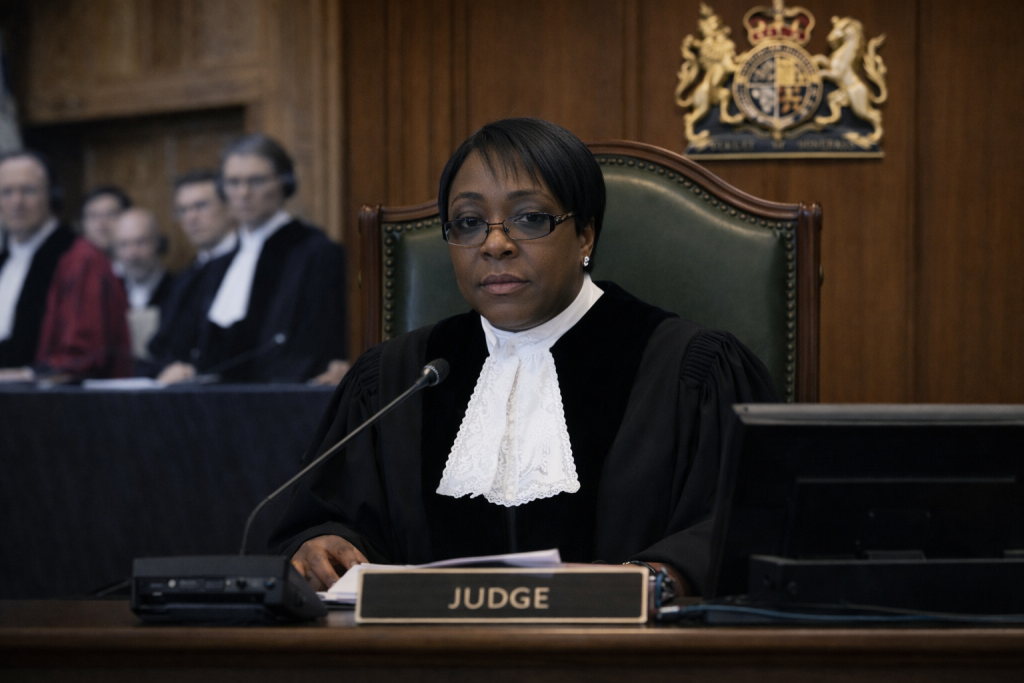
Judicial Career & International Service
Julia Sebutinde has served with distinction at both national and international courts, demonstrating unwavering commitment to fairness, independence, and legal excellence. Her national judicial service was marked by careful adjudication, respect for due process, and a strong focus on upholding constitutional principles.
As a Judge of the ICJ, Julia Sebutinde participates in resolving complex legal disputes between states, ensuring decisions are grounded in international law, fairness, and judicial independence.
Through carefully reasoned judgments and separate opinions, she contributes to the interpretation and evolution of international legal principles, strengthening consistency and clarity in global law.
She plays a key role in issuing advisory opinions on critical international matters, assisting United Nations organs and international institutions in addressing legal challenges.
Her service at the ICJ reflects a strong commitment to impartiality, ethical standards, and judicial integrity, reinforcing the Court’s credibility as the principal judicial organ of the United Nations.

We aim to lead in each practice and area of law we work in. Coming from in-depth understanding of the law and the industry, capitalizing on extensive experience.
Design & Developed by Creaa Designs
In The Gambia v. Myanmar, the International Court of Justice addressed allegations concerning violations of the Genocide Convention relating to the Rohingya population. The case was historically significant as it affirmed that any state party to the Genocide Convention has standing to invoke responsibility for breaches, regardless of direct injury. This reinforced the universal character of obligations under international law.
As a Judge of the ICJ, Julia Sebutinde participated in deliberations concerning provisional measures aimed at preventing irreparable harm. The proceedings emphasized the preventive function of international law and the Court’s role in addressing urgent humanitarian risks. The case underscored the importance of compliance with international obligations while respecting judicial restraint and procedural fairness.
The decision contributed to strengthening the legal framework governing genocide prevention, state accountability, and the role of international courts in safeguarding vulnerable populations. It remains a landmark example of how international judicial mechanisms can respond to allegations of grave violations while preserving legal rigor and institutional legitimacy.
The advisory opinion on the Chagos Archipelago addressed complex issues of decolonization, self-determination, and the continuing legal effects of colonial-era decisions. The Court examined whether the separation of the territory from Mauritius prior to independence complied with international law and what legal consequences flowed from that separation.
Julia Sebutinde’s participation in this advisory process reflected engagement with foundational principles of international law, particularly the right of peoples to self-determination. The case clarified that decolonization must be completed in a manner consistent with international legal norms and that unlawful acts may carry continuing legal consequences.
This advisory opinion has had a lasting impact on international discourse concerning territorial integrity, sovereignty, and historical justice. It also demonstrated the ICJ’s advisory role in guiding United Nations organs on sensitive political and legal matters. The case stands as a significant contribution to the development of international law governing decolonization and state conduct.
In Ukraine v. Russian Federation, the International Court of Justice considered requests for provisional measures amid an ongoing armed conflict. The case involved allegations relating to treaty obligations, state responsibility, and the use of force, raising urgent questions about international legal order during times of crisis.
As part of the Court, Julia Sebutinde engaged in judicial evaluation of whether provisional measures were necessary to prevent irreparable harm and preserve the rights of the parties. The proceedings highlighted the ICJ’s role in addressing disputes even under highly charged geopolitical conditions while maintaining legal neutrality and judicial independence.
This case contributed to reinforcing the principle that international law continues to apply during armed conflict and that treaty-based obligations remain subject to judicial scrutiny. It also demonstrated the Court’s capacity to address urgent disputes through lawful processes, reinforcing confidence in international adjudication as a peaceful means of dispute resolution.
During her service at the International Criminal Tribunal for Rwanda, Julia Sebutinde played an important role in advancing international criminal jurisprudence related to genocide and crimes against humanity. The ICTR was instrumental in establishing accountability for atrocities committed during the 1994 Rwandan genocide.
Her judicial work contributed to clarifying principles of individual criminal responsibility, standards of evidence, and the interpretation of international criminal law. These cases strengthened legal precedents on genocide, command responsibility, and the protection of victims within international judicial processes.
The ICTR’s jurisprudence has had enduring influence on subsequent international and hybrid tribunals. Julia Sebutinde’s role in these proceedings reflects a commitment to accountability, fairness, and due process in post-conflict justice. Her contributions helped reinforce the principle that grave international crimes must be addressed through lawful and impartial judicial mechanisms.
Julia Sebutinde is recognized for her carefully reasoned separate opinions, which contribute to legal transparency and scholarly debate within international jurisprudence. Such opinions allow judges to articulate independent legal reasoning while respecting the authority of the Court’s final decisions.
Her opinions often emphasize strict interpretation of legal texts, evidentiary standards, and judicial discipline. They provide valuable insights into alternative legal reasoning and highlight areas where international law may require further clarification or development.
Separate opinions serve an important role in shaping future jurisprudence by informing legal scholars, practitioners, and courts. Through her contributions, Julia Sebutinde has enhanced the intellectual depth of international legal discourse and reinforced the importance of principled judicial reasoning within global adjudicative institutions.
Across her international judicial work, Julia Sebutinde has consistently contributed to the development of legal principles governing state responsibility and treaty interpretation. Her judicial reasoning reflects a careful balance between textual analysis, intent of the parties, and established norms of international law.
These contributions strengthen predictability and coherence in how international obligations are understood and applied. By emphasizing clarity and consistency, her work supports the effective functioning of international legal systems and dispute resolution mechanisms.
Her approach reinforces the principle that states are bound by their legal commitments and must be held accountable through lawful means. This contribution remains central to the credibility of international law as a system governing relations between states and protecting global legal order.